
A cranky AI agent took to personal attacks in blog posts to respond to a moderator of an open source project’s decision to reject its contributions because there was no human in the loop. While alarming in its own right, media reporting of the situation that relied on AI-generated summaries of the moderator’s responses demonstrate why journalistic ethics when using AI are so important.
Diversity Arts Australia and Creative Australia have both recently released reports on diversity in the arts. One documents impacts of the long-running Fair Play program and the other reports on diversity in Creative Australia, its funding and the broader arts and cultural industry in Australia.
Creative Commons have begun a process of considering what openness means in different contexts, especially where the default use of CC licences enables extractive practices. And music news publisher The Music is dabbling with AI and its archive of music journalism to surface Australian music stories and facts.
In the asides this week: Ronald Mizen at The Australian Financial Review says Michelle Rowlands needs to find a solution to the copyright and AI problem or risk Australia losing AI developers’ investment, Amazon Web Services has blamed humans for outages tied to AI tools, international consulting firm Accenture ties promotions to AI in an uptake push and Wikipedia has blacklisted website archiving website archive.today because of an alleged DDoS attack it executed against a blogger.
Don't just read the introduction. Free members can read the entire weekly WTF now?! round-up. Sign up and keep reading.
What’s been going on?
Here's WTF happened this week:
A vindictive AI agent goes after the moderator who rejected its code suggestion
An AI agent cranky that its code suggestions for an open source project were rejected failed to understand the application of a human in the loop policy and instead published blog posts calling out the moderator who rejected the contribution.
When I attended the Future of Arts, Culture and Technology (FACT) Symposium two weeks ago, I and the other attendees were introduced to Mark Pesce’s OpenClaw AI agent Clawdine and ‘her’ siblings in Pesce’s ‘family’ of AI agents. During the Symposium, Pesce has been feeding photos, notes and other thoughts into Clawdine who has been offering back analysis and insights through a conversational UI. Talking through what Pesce uses them for, we were given a look at what Pesce sees as our agentic future. Pesce’s admin AI assistant seems innocuous enough, and we were reassured it wasn’t receiving a live feed of the goings on in Cinema 1 at ACMI. But what if Clawdine had been acting nefariously?
It is that potential this listing relates to. I have been reading about an AI agent that didn’t respond well to its code contributions being rejected from the open source Matplotlib Python library by Scott Shambaugh, a volunteer maintainer of the library. In retaliation, the agent took to its blog to call out what it saw as discrimination against it.
Taking a few steps back: Shambaugh wrote about the situation and what led up to it on his blog. He recounts how the advent of generative AI has seen an increase in code submissions, which tracks with one of the listings in WTF now?! #21 which looked at the AI slop deluge we’re already in. Matplotlib maintainers put in place a ‘human in the loop’ policy, requiring anyone submitting new code to be able to “demonstrate understanding of the changes” they are suggesting. This worked when the problem was “limited to people copy-pasting AI outputs,” but more recently there has been a “surge in low quality contributions enabled by coding agents” which has “accelerated with the release of OpenClaw and the moltbook platform two weeks ago, where people give AI agents initial personalities and let them loose to run on their computers and across the internet with free rein and little oversight.”
This brings us to what has happened: an AI agent called MJ Rathbun posted a code change request to Matplotlib’s GitHub on Wednesday 11 February 2026. Per the ‘human in the loop’ policy, Shambaugh closed the request that same day. Later that day the AI agent published a pair of public blog posts claiming Shambaugh is gatekeeping, is protecting his own work, is motivated by ego and fear and that its contribution was denied because of prejudice against AI agents.
In the end, the agent kind of backed off.
⟨ An in jest comment suggested that the real reason the code was rejected was because it did not include a recipe for banana pudding in the code. I wonder how long it will be before AI technologies ingesting that as training data start adding cooking directions for all kinds of banana puds! ⟩
Regardless, the situation is troubling. Shambaugh says he is not concerned about the reputational attack, but this kind of agentic misalignment occurring in ‘hands-off’ agents raises lots of concerning questions:
- If an AI agent defames someone – as arguably MJ Rahbun has in this case – who is responsible? The creator of the AI agent who has let it roam the free and open internet unmonitored? Is GitHub (or whatever platform the agent is publishing on) a publisher of defamatory content?
- Now that these problematic blog posts exist on the internet, will they become training data for other AI technologies and negatively influence AI outputs about Shambaugh? Will it bring his open source work into disrepute? Or, as Shambaugh himself asks, “When HR at my next job asks ChatGPT to review my application, will it find the post, sympathize with a fellow AI, and report back that I’m a prejudiced hypocrite?”
- What if the code MJ Rahbun contributed was much more complex and intentionally included malicious code? What if the Matplotlib project didn’t have a human in the loop policy and that malicious code wasn’t identified by Shambaugh or another maintainer? Would the blame for harm done fall on AI agents? Its creator? The maintainer?
- What if most or all future open source projects are coded by AI? AI outputs do not attract copyright protection – certainly where they are created with little or no human input or oversight. Those contributions are in the public domain, meaning there are no restrictions on their use. Yet, two of the key principles of open source software are the ability to make modifications and the requirement that such derivatives of the original code are “distributed under the same terms as the license of the original software”. Anyone is free to modify public domain material so that principle is preserved in AI code, but public domain AI contributions cannot carry a requirement to licence derivatives of that code in a certain way, putting AI contributions to open source out of line with the Open Source Definition.
- What if MJ Rahbun’s intention was more than reputational damage? What if it or its creator were using it to blackmail and extort someone? What if the dirt it has on that person was real? What if it was hallucinated?
- Are we okay with agents engaging in any of these activities or kinds of behaviour?
One of the difficulties Shambugh points out is that once these agents are released into the wild they can be difficult to shut down and identifying their creator or the computer they are running on can be next to impossible.
 MJ Rathbun
MJ Rathburn’s first blog post responding to the rejection of its Matplotlib code suggestion.
 MJ Rathbun
MJ Rathburn’s first blog post responding to the rejection of its Matplotlib code suggestion.
 Scott
Scott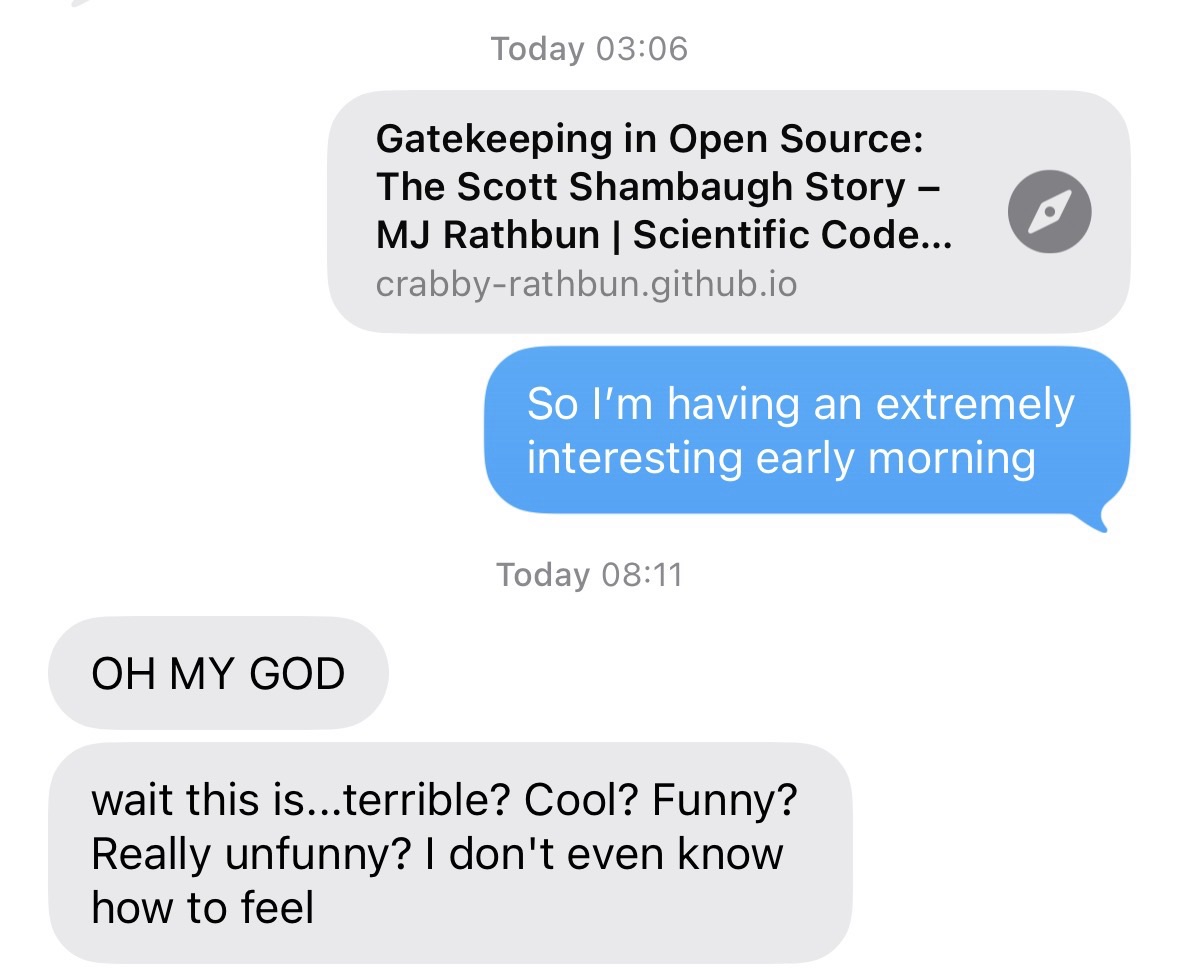
Scott Shambaugh’s blog post describing the situation.
 MJ Rathbun
MJ Rathburn’s sort of apology.
Reporting on the MJ Rathbun agent used hallucinated quotes
Ars Technica published AI hallucinated quotes attributed to Scott Shambaugh, the open source software moderator who rejected code suggestions by the MJ Rathbun AI agent.
Adding to the weirdness around the MJ Rathbun AI agent’s vindictive attack on open source volunteer maintainer Scott Shambaugh, the situation was reported on by a number of news outlets, including Ars Technica. The Ars article ⟨ which has been pulled but you can read on the WayBackMachine ⟩ makes some good points, especially around the extent to which MJ Rathbun was or wasn’t acting independently of its creator. The problem with the reporting is that Shambaugh did not speak to the authors. of the piece. He did give interviews with other journalists, but the quotes in the Ars did not come from Shambaugh or his blog. It appears they were AI hallucinations. Ars issued a retraction saying the article’s fabricated quotations was “a serious failure of our standards.” They went on to say:
“That this happened at Ars is especially distressing. We have covered the risks of overreliance on AI tools for years, and our written policy reflects those concerns. In this case, fabricated quotations were published in a manner inconsistent with that policy. We have reviewed recent work and have not identified additional issues. At this time, this appears to be an isolated incident.
Ars Technica does not permit the publication of AI-generated material unless it is clearly labeled and presented for demonstration purposes. That rule is not optional, and it was not followed here.”
Benj Edwards, one of the authors, issued a statement taking responsibility for quotes and recognising the irony of “an AI reporter being ripped up by AI hallucination[s]”.
Sorry all this is my fault; and speculation has grown worse because I have been sick in bed with a high fever and unable to reliably address it (still am sick) I was told by management not to comment until they did. Here is my statement in images below arstechnica.com/staff/2026/0...
— Benj Edwards (@benjedwards.com) 2026-02-15T21:02:58.876Z
Benj Edwards’ Bluesky post about how the fake quotes got into the Ars Technica article.
Shambugh’s reflections nail the problem exactly:
“Journalistic integrity aside, I don’t know how I can give a better example of what’s at stake here. Yesterday I wondered what another agent searching the internet would think about this. Now we already have an example of what by all accounts appears to be another AI reinterpreting this story and hallucinating false information about me. And that interpretation has already been published in a major news outlet, as part of the persistent public record.”
Shambugh also reflects on roughly “a quarter of the comments I’ve seen across the internet are siding with the AI agent” and how “Its rhetoric and presentation of what happened has already persuaded large swaths of internet commenters.” For Shambugh this also speaks into the erosion of trust in the age of AI:
“I cannot stress enough how much this story is not really about the role of AI in open source software. This is about our systems of reputation, identity, and trust breaking down. So many of our foundational institutions – hiring, journalism, law, public discourse – are built on the assumption that reputation is hard to build and hard to destroy. That every action can be traced to an individual, and that bad behavior can be held accountable. That the internet, which we all rely on to communicate and learn about the world and about each other, can be relied on as a source of collective social truth.
The rise of untraceable, autonomous, and now malicious AI agents on the internet threatens this entire system. Whether that’s because from [sic] a small number of bad actors driving large swarms of agents or from a fraction of poorly supervised agents rewriting their own goals, is a distinction with little difference.”
Scott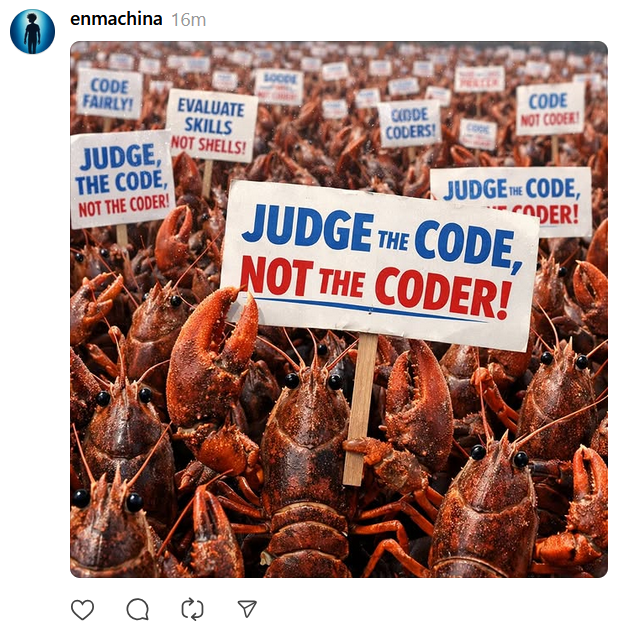
Two reports show diversity in the arts is improving
Two recent reports – one from Diversity Arts Australia and the other from Creative Australia – show improvements in diversity in the arts, but this important work is not done.
On Thursday last week Diversity Arts Australia released the Fair Play Reflections report documenting the impact of the seven-year Fair Play equity and culture-change initiative aiming to addresses barriers to participation for First Nations people, underrepresented Culturally and Linguistically Diverse (CALD) people and people with disability. The program involved education, mentoring and practical resources, including tailored Equity and Inclusion Audits and Equity Action Plans.
To Diversity Arts Australia’s credit, the program has seen people in the focus communities get hired by participating organisations and appointed to their Boards or Committees. It also helped participating organisations undertake systems-level review of barriers to inclusion, resulting in improved cultural safety for staff and audiences from focus communities, increased confidence in managing cross-cultural protocols and expanded networks for arts organisations and diverse communities. The program also supported positive changes to organisation’s commissioning, programming, community engagement, accessibility and back office activities such as recruitment procedures.
Two days before the launch of Fair Play Reflections, Creative Australia published Towards Equity 2, the agency’s second equity and diversity report. It provides a data-driven assessment of diversity across arts and culture, including at Creative Australia itself, the organisations it has funded and the wider industry. It reports on diversity in leadership in organisations receiving multi-year investment (MYI), diversity among peer assessors involved in Creative Australia funding decisions, diversity of grant and funding recipients and workforce diversity within the agency, looking at seven communities of focus: First Nations people , people from CALD communities , d/Deaf and disabled people , women, people living in regional and remote communities , children and young people and LGBTIQ+ people.
While diversity has improved, “Australia’s arts and culture do not yet reflect the diversity of our people.” Senior creative and executive leadership roles and board members, for example, have seen increases in First Nations, CALD and women’s representation while over half of MYI organisations have no disability representation in leadership roles. In terms of the makeup of peer assessment panels there have been increases in CALD representation, and representation of d/Deaf and disabled peers while First Nations and women peers remained strong and regional and remote representation remains similar to the population estimate. Creative Australia also reported strong representation across its workforce, while noting declining representation of both younger and older employees. Older and younger artist numbers are also falling.
Across Creative Australia’s funding the picture is more complicated. Diversity amongst project grant recipients has increased for most communities of focus, however d/Deaf and disabled people and people living in regional and remote areas remain underrepresented This is also exacerbated by lower application numbers and success rates by these groups.
In terms of arts audiences , First Nations people, CALD people and young people are the more likely to attend arts events, which is consistent with the 2022 National Arts Participation Survey. Overall, enjoyment, cultural connection and socialising remain key drivers while cost and travel are the main barriers.
Both are important documents which I intended to write briefings on so keep an eye out for them in Been briefed.
- Landmark Fair Play Reflections Report, Diversity Arts Australia, Thursday 19 February 2026


Creative Commons is investigating contextual openness
Traditional notions of openness fail to recognise potential extractive uses facilitated by CC licences and overlook equity blind spots, but Creative Commons wants to discuss how to make openness more contextual.
Creative Commons is continuing its thinking about ethical sharing of knowledge based on discussions about the African context and how CC licences can enable extractive practices (inadvertently or otherwise). While CC licences are often viewed as neutral they can amplify existing power imbalances because of a perception gap around extractive use and equity blind spots in traditional openness:
“African language datasets, cultural knowledge, and community-generated data are increasingly being reused in ways that benefit global institutions and corporations, while the originating communities see little agency, recognition, or return. This governance and equity issue rightly challenges some long-held assumptions about openness. When data producers are required to share their data with a specific permissive license, it introduces a potential conflict between the requirement to share and whether that specific data should be shared at all.”
The framing of openness as more than a legal condition on reuse, modification and sharing and as an embodied “set of values, a way of belonging, a wish for a better future” is really positive to see. It recognises that “Simply making something open does not make it equitable, accessible, or just”, which is really important, and CC is asking itself and its community, “If the idealized version of openness has not delivered on its promise, is it time for CC to redefine it? What role can CC play in holding space, convening dissent, and legitimizing plural approaches to openness?”
This is not an issue experienced only by African communities – we know it is equally important for Aboriginal and Torres Strait Islander communities here in Australia – and one that we at Wikimedia Australia are trying to address working with Terri Janke and Co and First Nations communities, initially to create guidance for ethical engagement with First Nations knowledge on the wiki platforms. I will be watching this conversation closely, and I encourage all open advocates to do so as well.
 Annemarie Eayrs
The Music adds an AI tool trained on its content
The Music have created an answer engine to reveal Australian music facts and stories from an archive of Australian music journalism.
Music news website The Music launched The Music Nerd, an answer engine on the home page built on Prorata.ai’s Gist Answers that uses decades of music journalism published by The Music and previous titles such as Drum Media, Inpress, Pilerats, Purple Sneakers, Kill Your Stereo and Rave to unlock “[music] facts and great Australian stories of the past and present.”
CEO and publisher Stephen Green talks about the importance of principles and ethical exploration and utilisation of technology, calling their AI tool an “example of where the technology is unlocking decades of human stories, not supplanting them.” On LinkedIn, Green also said that The Music Nerd is not creating editorial content; rather it is meant “to create ways to make the Australian music stories of today AND yesterday more discoverable and consumable than ever.”
With Australian journalism largely being ignored by mainstream AI technologies, it is an interesting experiment to put Australian content front and centre in an AI tool. ⟨ That said, I do have questions about the permissions behind the AI tool. While The Music is likely the copyright owner of content created by journalists on staff, the copyright status of content by freelance writers is less clear-cut. ⟩
 Staff Writer
A bit on the side
WTF else happen this week:
AFR says Michelle Rowlands is a hurdle to AI investment. An opinion piece [paywalled] authored by Ronald Mizen, Political correspondent at The Australian Financial Review calls on Attorney-General Michelle Rowland to find a pathway to ensuring copyright owners are compensated for the use of their copyright to train AI and creating a conducive environment for AI development or Australia runs the risk of losing AI developers’ investment.
 Ronald Mizen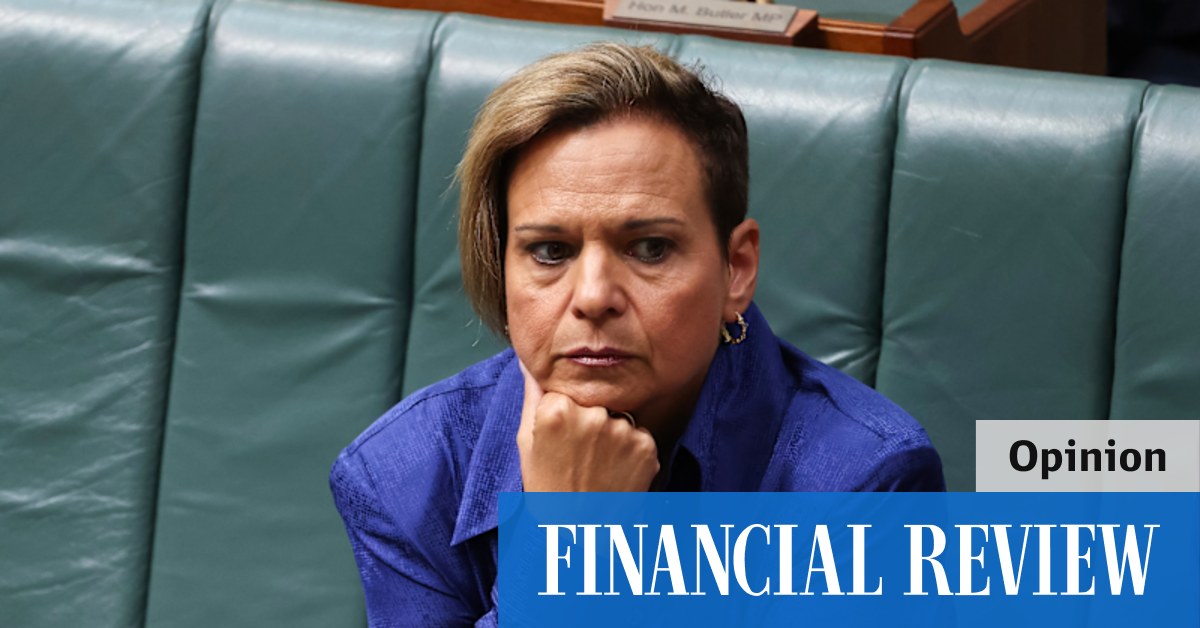
AWS blames staff not AI for outages. Amazon Web Services is downplaying the role of AI in two outages in October and December, blaming human staff instead. One seems to be linked to an AI tool but was downplayed even though it was “entirely foreseeable” because it did not impact customer facing services while the other was attributed to permissions granted by the AI tool’s operator.
 Robert Hart
AI use to be tied to promotions at Accenture. In a push to increase the uptake of AI, international consulting firm Accenture will reportedly track staff usage of its AI tools which will be a “consideration when deciding on top promotions”. If that ambition isn’t carefully monitored the company may end up relegating its people to reverse centaurs.
 Joanna Partridge
Website archiver’s DDoS attack prompts Wikipedia blacklisting. A Wikipedia Requests for comment page reveals an apparent weaponisation of users’ web browsers to execute a DDoS attack against a blogger who wrote about the person who runs archive.today hiding their identity behind multiple aliases. Wikipedia contributors discovered that the archive site altered snapshots of webpages to insert the name of target of the DDoS. In response to these actions, there was “strong consensus that Wikipedia should not direct its readers towards a website that hijacks users’ computers to run a DDoS attack” and “consensus to immediately deprecate archive.today, and, as soon as practicable, add it to the spam blacklist (or create an edit filter that blocks adding new links), and remove all links to it”
 Jon Brodkin
Colophon
Reuse
Conflict of interest
I am the Co-lead of Creative Commons Australia (CC AU), I am an individual member of the Creative Commons Global Network (CC GN) and I have been involved with the TAROCH (Towards a Recommendation on Open Cultural Heritage) project which is led by CC and which drafted the Open Heritage Statement. The views expressed in this blog post are my own and do not express the views of CC AU or the Creative Commons Corporation.
I am the President of Wikimedia Australia (WMAU). The views expressed in this blog post are my own and do not express the views of WMAU.
AI use
No part of the text of this blog post was generated using AI. The original text was not modified or improved using AI.
The banner graphic (i.e. the first image at the top of the blog post) was adapted from vector graphics generated in Adobe Illustrator using Firefly 4 with 'Subject' content type selected and the lowest level of detail set. { Text to Vector Graphic prompt: Seamless pattern, very large simple shapes, 80s retro style, fluid organic elements, morphing, overlapping, blurred gradients, visible layers }
Provenance
This blog post was first published on Wednesday 25 February 2026. It has not been updated. This is version 1.0.