


Workforce and skills shortages in the arts, US Big Tech lobby targets foreign laws it doesn’t like and how did Australian universities become bad places to work?
This week's round-up comes to you from a hotel room in Den Haag (The Hague)! I am here to participate in the Towards a Recommendation on Open Cultural Heritage (TAROCH) Workspaces meeting. ⟨ It is still technically Sunday here in Central European Time! ⟩
Over more than 500 pages Creative Australia and Service and Creative Skills Australia (SaCSA) lay out what many of us in the arts sector have known for awhile; there are gaping holes in lots of needed skills and recruiting certain roles is difficult. Technical and production roles across the board, and in some areas there's a shortage in skilled staff in management and leadership, finance and accounting, marketing and communications and business support.
The American Big Tech lobby group the Computer and Communications Industry Association (CCIA) have used Trump’s US trade review to let fly at a number of countries and their regulatory regimes CCIA claims are hurting poor old Big Tech. It is hard to have too much sympathy for the big tech players, but, behind all the overstated ‘discrimination’ and hyperbolic claims, CCIA’s submission does give one of the most comprehensive overviews of global tech regulation I've seen. And the numbers they are throwing around will leave you saying WTF now?!
Also, a rise in domestic university enrollments is a welcome trend for our beleaguered universities, but there is concern mismanagement is undermining student life, staff satisfaction and the good standing of our universities. Upper leadership across many campuses are being called out for horrendous restructures, poor transparency, no accountability, hostility, noncompliance with employment laws and more.
Mariah Carey and Miley Cyrus have both received verdicts from courts related to copyright claims against them. Carey’s Christmas wish came true, but not so for Cyrus. Her legal team made an error proving they were right ‘til they weren't. It looks like the ‘Flowers’ copyright case will be heading to court.
Plus the bit on the side: Another court reaffirmed the need for human authorship to attract copyright protection of AI-generated content, the Resale Royalty expands to more countries, CommonsDB has ambitious plans for increasing the reuse of Public Domain and openly licensed content online, Bluesky makes marketers happy and more.
Don't just read the introduction. Free members can read the entire weekly WTF now?! round-up. Sign up and keep reading.
What's been going on?
Here’s WTF happened this week:
Workforce report confirms critical workforce and skills shortages in the arts
Sadly it comes as no surprise that the Creative Workforce Scoping Study found critical workforce and skills shortages.
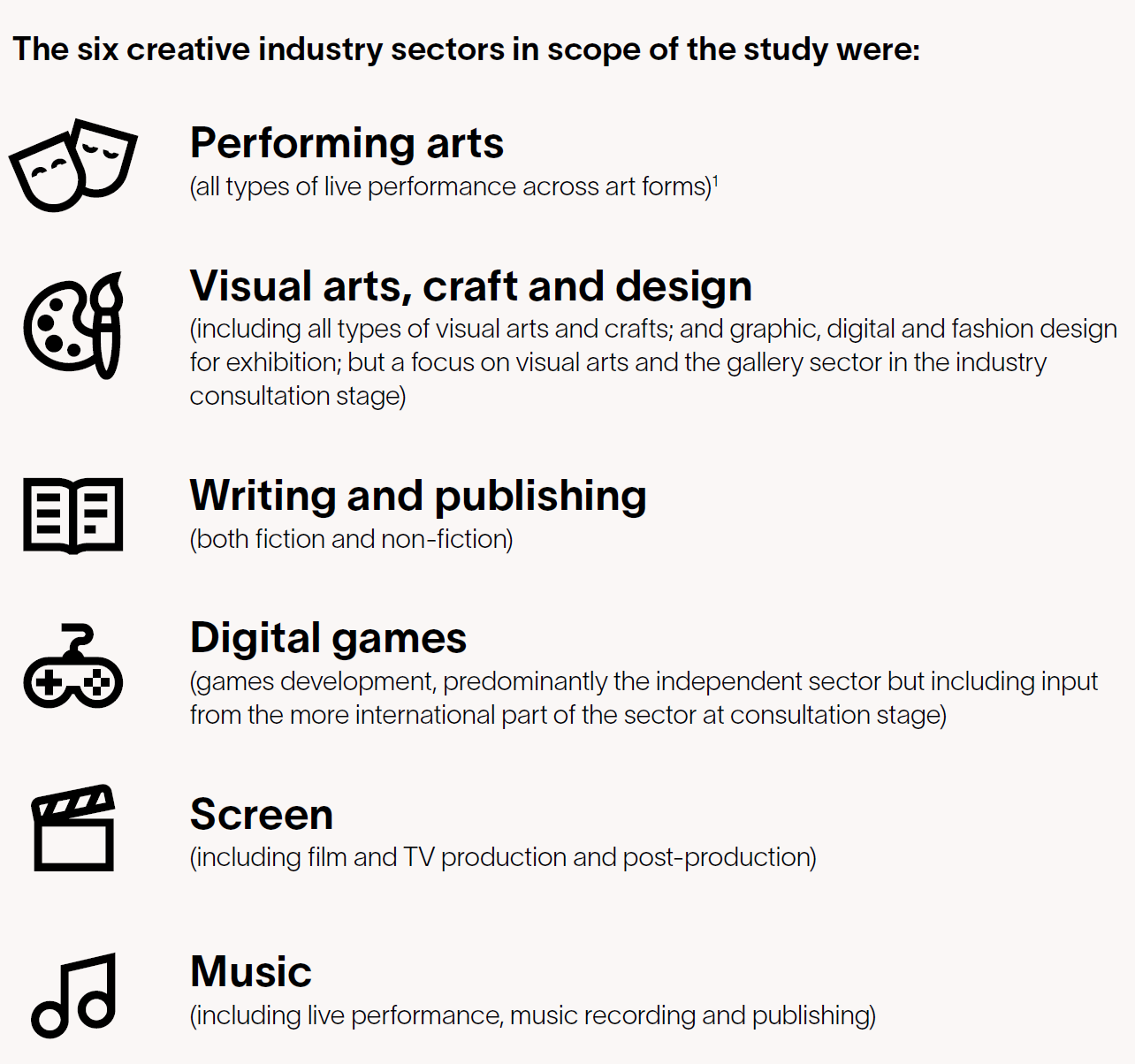
The Creative Workforce Scoping Study Report that came out last week is a voluminous tome looking at workforce challenges and required skills in six creative sectors: performing arts, music, visual arts, craft and design, writing and publishing, digital games and screen.
I haven't read it all yet ⟨ it is over 550 pages! ⟩ but here's what I've noted from a few looks through:
The sector is facing critical workforce and skills shortages “exacerbated by the economic climate; precarious work conditions; generational shifts in workplace expectations; a disconnect between formal education and industry needs; an imbalance between creative and business skills; technological changes; impacts of the COVID-19 pandemic; workforce exits; low wages; competition with better paid jobs and industries; limited career progression opportunities and visible pathways; overwork, leading to burnout and leadership challenges; regional barriers to workforce participation and training; and slow progress on diversity, equity and inclusion due to structural barriers and limited resources, capacity and knowledge”.
Technical and production shortages are evident across sectors while acute shortages are experienced around lighting designers in the performing arts, game artists in video games and animation and visual effects in screen. Finance and accounting is in short supply everywhere except games and marketing and communications, management and business support roles are needed in visual arts, craft and design. There is a lack of management and leadership skills in all areas and more business skills for creatives is needed in all sectors except screen.
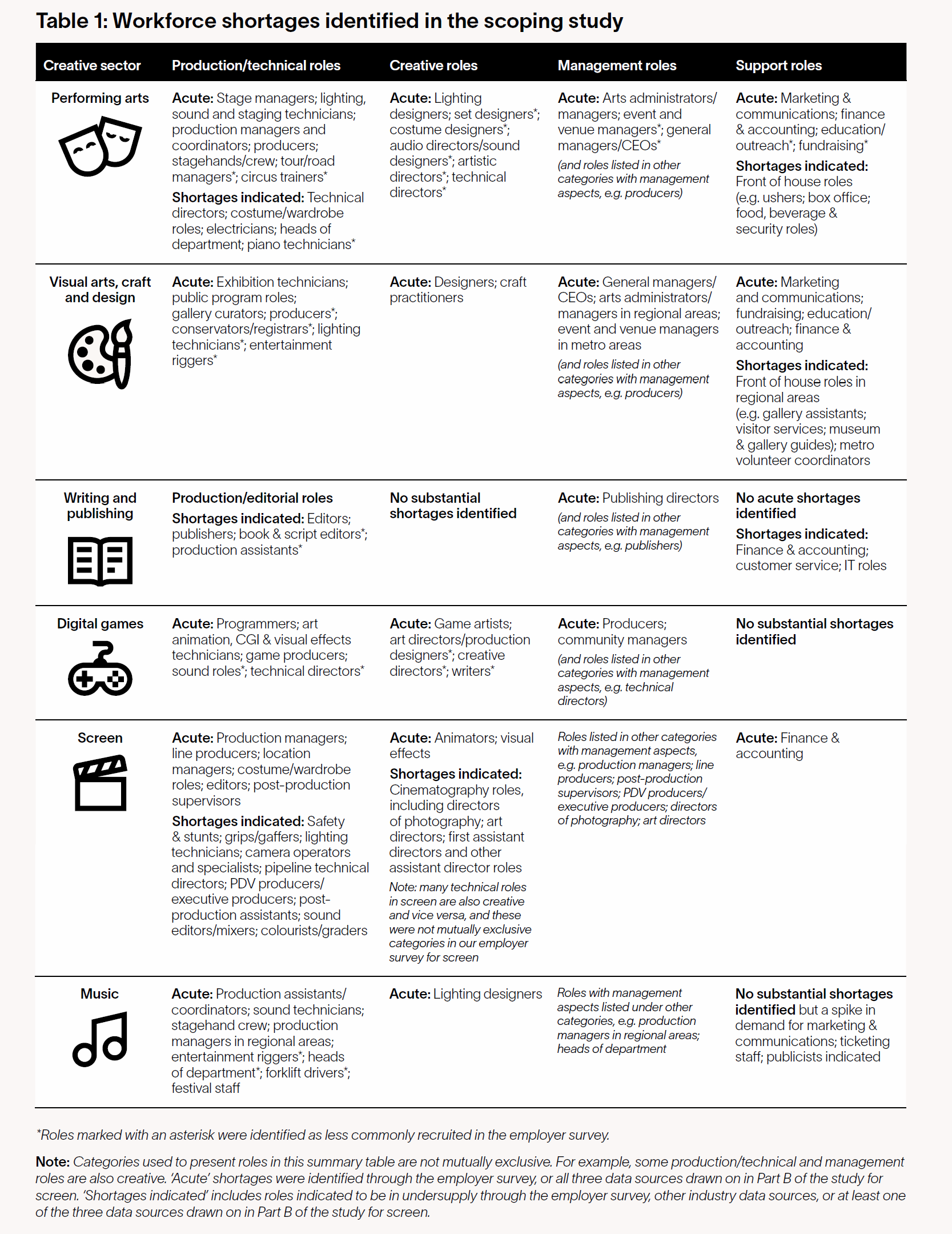
The more commercial parts of the industry – games, screen, publishing and music – cited attracting talent globally and shortages of skilled mid-career and senior workers as root causes of their workforce challenges. They also flagged balancing financial viability with creative goals, dynamic policy settings and fluctuations in workforce demand, the need to innovate and adapt, especially in response to rapid technological change and changing consumer behaviour, reliance on freelance workers not building a skilled workforce, managing financial risks and building workforce skills on demand as issues.
In the subsidised parts of the sector – including visual and performing arts and the experience of artists, writers and musicians – see a lack of funding for operating costs and to do longterm strategic planning as issues, as is reliance on project funding, temporary contract, noncompetitive salaries for business support and specialised technical and production roles, relying heavily on volunteers and underpaid staff, lack of financial stability leading to job insecurity and limited career development opportunities, burnout from reliance on multiple income streams and emotionally taxing work environments, conflicts between cultural, community and commercial imperatives and limited recognition of the value of creative education, career pathways and work. Yep, it's a lot!
It is good to see the report identifies existing initiatives in the arts trying to tackle workforce and skills shortages, and that these will inform further phases of work. The report emphasises the need for initiatives that fill the gaps in formal education and training and which bridge the gap between formal education and industry needs and suggests mentoring, microcredentials, other on-the-job training and opportunities for lifelong creative learning. And it also flags that workforce development responses need to be coupled with improving workplace conditions, salaries and perceptions of creative work.The report was conducted by Creative Australia for Service and Creative Skills Australia (SaCSA) and delivers on a national cross-portfolio commitment in the National Cultural Policy, Revive. Insights from the study will inform SaCSA’s Workforce Plans, along with reviews of vocational education and training (VET) and other education, training and workforce development initiatives.


US tech lobby critisises "discriminatory" trade regulation impacting US technology companies
A US tech industry association has outlined more than 75 active or proposed laws and regulatory schemes impacting American big technology companies.
The Computer and Communications Industry Association (CCIA) has used a submission to the Office of the US Trade Representative (USTR) to take aim at foreign “unfair trading practices” that create digital trade barriers that impact American technology companies. The USTR Request for Comments To Assist in Reviewing and Identifying Unfair Trade Practices and Initiating All Necessary Actions To Investigate Harm From Non-Reciprocal Trade Arrangements comes in response to the Trump administration's executive orders related to US trade policy.
Within “the thicket of barriers U.S. firms encounter in foreign markets” CCIA – whose members include more than 20 of the tech industry's biggest players, including X (formerly Twitter), Meta, Google, Apple and Amazon – specifically names a number of Australian existing or proposed regulations, including the social media age ban, local content quotas imposed on streaming services and the News Bargaining Incentive (the next iteration of the News Media Bargaining Code). Austria, Belgium, Brazil, Canada, Colombia, Czechia, the European Union, France, Germany, India, Indonesia, Italy, Japan, Kenya, South Africa, South Korea, Spain, Türkiye, the United Kingdom, New Zealand are all also listed as countries or territories with active regimes or regimes under consideration.
When about “half of the revenue generated by CCIA members, similar to the tech sector generally, come from exports and sales abroad” naturally trade issues are important to them. The wide view of their submission seeks to demonstrate the size and scale of regulation and compliance its members are facing across the globe. To that end, CCIA expresses concern about the known and unknown costs their members face in light of foreign policy.
Quantifiable costs are those for which a dollar amount can be determined. They cite the European Union (EU) GDPR, Canada's Digital Services Tax (DST) and Australia's News Media Bargaining Code specifically as examples where the cost to US Big Tech is calculable. Beyond the direct cost, CCIA flags compliance costs, opportunistic litigation, fines and penalties, lower revenue and lower returns on investment as additional burdens members are hit with.
The document throws out some huge numbers – £358 million, €500 million annually, AU$250 million annually, are just a few – which I found difficult to make meaningful. I tried to do a calculation in Australian dollars of all the stated costs CCIA mentions in the submission. It comes to roughly $45 billion AUD per year.
On top of those hard figures, there is also a range of hard to quantify costs. These come up where regulatory interventions require US companies to make changes to, delay or forgo their services or change the way they operate. CCIA notes that calculating “tangible money lost [in these cases] can be elusive”. By way of illustration, the direct compliance costs for regulation such as bans on self-preferencing like what is included in the EU Digital Markets Act “may not capture the additional burden of re-engineering services.” Likewise it is difficult to discern the cost when a company delays releasing a product or opts to exit a market or to not enter it in the first place. CCIA also warns of the incalculable costs attributable to the “contagion effect”, where policy introduced in one country prompts the same or similar policies in other countries.
CCIA identifies seven categories of obstructive policy:
- Taxation of digital products and services – For CCIA they see DSTs and customs duties on electronic transmissions as the “discriminatory taxes” that disproportionately impact US companies and that are based on “unfounded assertions that digital service suppliers fail to pay their fair share of taxes and should be subject to additional levies in the jurisdictions they serve.”
- Mandatory payment obligations benefitting domestic competitors – CCIA also points to a “growing phenomenon” of “policies characterized by their extractionary and redistributive nature.” In this category they group regulatory initiatives by industry. The first industry they discuss is news and the first thing on their illustrative list is Australia's News Media Bargaining Code. They characterise the Code as ‘coercive’ agreements entered into because of the threat of greater legislative intervention. Local content quotas for audio visual content are also in this category. Schemes exist in some countries and such a scheme was included in Revive Style: italics, the National Cultural Policy, but has not yet been enacted. Also in this category is redistribution to ISPs (Internet Service Providers) for infrastructure costs.
- Asymmetric platform regulation – Here CCIA are targeting ‘platform regulation’ broadly; what they describe as “[the] general but ill-defined desire for “platform regulation,” unsupported by evidence of consumer harm”. They claim this “is spurring digitally-focused ex-ante regulation around the world”. CCIA sees this kind of regulatory intervention as rules “often tailored to specifically impede the legitimate business models of U.S. companies, including their administration of app stores, their ability to share data across services, and their ability to integrate products for consumer benefit and increased efficiency”.
- Data and infrastructure localisation mandates and restrictions on cloud services – CCIA are not shy about making their thoughts known on so-called ‘technology sovereignty’ initiatives: “One of the most egregious barriers to digital trade is the growing practices of data localization and mandated use of domestic computing infrastructure.” They do not support moves by governments to ensure domestic data stays with its country of origin or compelling US technology companies to use local infrastructure providers.
- Potential challenges to the development of AI – You've probably guessed that this category is about attempts to regulate AI. The submission glosses over the important work happening world-wide to ensure risk, ethics and safety are appropriately considered in AI development. Target SCIA minimises those objectives based on an as yet unrealised potential for scope creep: “As governments seek to advance regulations with the declared aim of promoting safety and privacy, they may also face pressure to slow competitive threats and protect local market advantage.”
- Government-imposed restrictions on internet content and related access barriers – This category is focused on State-actors that engage in “censoring, filtering, and blocking of internet content, as well as targeted DNS and [web]site blocking”. This category also invoices throttling of internet services and executing internet shutdowns. Sure, there are costs incurred by Big Tech here, but defending the human rights concerns goes further than making sure freedom of speech is part of US trade relations.
- Import and export restrictions undermining e-commerce shipments – CCIA also flags a range of import and export policies that “can serve as significant barriers to operating in these markets and undermine the cross-border delivery of goods and services, and add large expenses for U.S. companies serving these markets”.
Trump may be trumpeting threats of greater trade tariffs against friend and foe alike, but the CCIA isn't calling for retaliatory tariffs. They recognise that the threat of tariffs can be useful in incentivising trade partners, but see removing barriers to US companies as the goal. They go so far as to caution that tariffs can incur costs and unintended consequences, including increasing input costs for US companies. Where remedial trade measures are taken they say those actions should “not undermine U.S. companies’ export interests, supply chains and domestic operations”.
What’s worth reading on US tech companies and Trump's trade war:
 Brad Ryan in Washington DC



 The White House

 The White House

The Atlantic released a search tool to know if Meta used your book as training data
Now you can quickly and easily search for an author in the millions of items in the pirate book and academic research library Library Genesis.
We know Meta used the pirated books database LibGeb to train its Llama AI but how do you know if you were included in it? With The Atlantic’s search tool you can ‘Search for an author in LibGen’. While an easy interface to conduct a search is new, news of Meta’s use of Libgen is not:
“Until now, most people have had no window into the contents of this library, even though they have likely been exposed to generative-AI products that use it… To show the kind of work that has been used by Meta and OpenAi, I accessed a snapshot of LibGen’s metadata—revealing the contents of the library without downloading or distributing the books or research papers themselves—and used it to create and interactive database that you can search…”
There are some important caveats:
- Just because you are in this snapshot of LibGen doesn't necessarily mean Meta or Open AI used your book or article; they may have omitted some content or your content may have become part of LibGen after either company had harvested it.
- Just because your works aren’t found doesn’t mean they aren’t in there; LibGen’s messy metadata does compromise the search tool a little.
- ⟨ I added this one to Reisner’s list but it rates a mention: ⟩ Just because your works aren’t in this list doesn’t mean they aren’t in a version of LibGen somewhere; there are many instances of the list hosted at different places on the internet so there will be those that are different to the verison The Atlantic used.
Strangely, I haven't seen many Australian authors discussing it and whether their works are included (yet!) but I did see Alison Croggon call for a class action on LinkedIn. Where ever individuals and collectives of Australian authors land on how to respond, the Australian Society of Authors is encouraging affected Australian authors to let them know by completing this Google Form.
What’s worth reading on The Atlantic’s LibGen search:
 Alex Reisner

 Alex Reisner

Mariah Carey & Miley Cyrus received very different copyright verdicts
‘All I Want for Christmas is You’ isn't a copyright infringement making it Christmas morning for Mariah Carey, but Miley Cyrus’ ‘Flowers’ case continues.
Mariah Carey’s ‘All I Want for Christmas is You’ has been cleared of copyright infringement by a US court. The court held the song was not an infringement of a Vince Vance and the Valiants’ song of the same name. Carey’s lawyers reportedly successfully argued that “The claimed similarities are an unprotectable jumble of elements: A title and hook phrase used by many earlier Christmas songs, other commonplace words, phrases, and Christmas tropes like 'Santa Claus' and 'mistletoe'." Judge Mónica Ramírez Almadani agreed, commenting that the two songs simply shared "Christmas song clichés" common to several earlier hits. Christmas clichés or not, Mariah Carey’s wish came true!
Miley Cyrus hasn't been so lucky. Her push to have a copyright claim against her hit ‘Flowers’ dismissed has been denied. The matter relates to whether ‘Flowers’ infringes Bruno Mars’ song ‘When I Was Your Man.’ Co-writer of that track Philip Lawrence transferred the rights to Tempo Music Investments, who are pursuing the matter. Cyrus's legal team tried to argue Tempo wasn't able to sue because it did not have the consent of the other writers. The judge corrected them, saying, “Because Lawrence as a co‐owner could sue for infringement, Tempo as co‐owner, in lieu of Lawrence, can sue for infringement without joining the other co‐owners of the copyright.” It seems Cyrus' legal team were right ‘til they weren't. Miley didn't want to fight, but now she has to.
What’s worth reading on Carey and Cyrus’ copyright cases:


 Steven J. Horowitz

The competence of university leadership across campuses is in question
Domestic university enrollments are up but lots of our unis are facing criticism over how they are managed.
Over half of Australian universities reported an increase in domestic student enrollments in 2025. Of course, these figures are pre-census date – the last day students can withdraw from a course or degree without incurring fees – so it is likely those gains will actually be smaller than stated. Still it seems things may be looking up for Australian struggling universities. In particular, it seems nursing and education degrees are popular, likely attracting students because they are seen as safe career options, have lower student fees and, for education, a government commitment to pay students for compulsory prac placements.
While renewed student numbers suggest people still see the value in a university degree, concerns are mounting about university governance. Two separate news pieces this week detail claims of poor management, censoring and harassment, worker exploitation and more against a number of our university's upper management.
Former Australian National University (ANU) Chancellor Gareth Evans took to email to declare the university’s current leadership under Chancellor Julie Bishop and Vice-chancellor Genevieve Bell has “No competence. No judgment. No shame.” Bell is one year in the seat while the national university is part way through a massive restructure that will likely see 650 jobs lost. At the same time it has been revealed that Bell was still being paid by Intel, her former employer, in addition to her $1.1 million university salary. Bishop is also under fire for consultancy contact awarded to close colleagues and the fact her ANU staff are also employed by her own private consulting work.
Criticisms of university leadership is not limited to ANU though. The Saturday Paper ran a piece looking at restructuring, job cuts, underpaying staff, leaders holding other roles, the awarding of consulting contracts to consultancies leaders are associated with, hostility towards staff who ask questions or raise concerns about management, and the list goes on. As Ross says in The Saturday Paper:
"The management of Australian universities has often been controversial but never more so than in the years since the pandemic, when global forces shattered any illusion that these institutions might have been run well.
Instead, decades of cumulative policy, funding and cultural decisions have exacted a stunning price on the concept of an institution that produces public knowledge for public good."
It is a long and worrying article filled with alarming anecdotes of the toxic cultures blooming in many of our universities. The article ends by recounting points made by the Tertiary Education Quality and Standards Agency (TEQSA) and the Council for the Humanities, Arts and Social Sciences (CHASS). I've included a particularly telling quote from each here:
“The risks are significant, [TEQSA] says, and near universal. They include: “Limited expertise, over-corporatisation, poor decision-making processes, poor management of conflicts of interest, challenges in exercising sound judgment on complex social, cultural or community issues and insufficient oversight of the management of key risks.””
“The effect of universities’ non-compliance with the law has not only been the exploitation of skilled and committed workers but damage to the universities’ social licence in the community,” the [CHASS] submission says. “Universities are now widely regarded as bad employers, even lawless bosses, with inevitable impacts on public support for their activities.”
What’s worth reading on university enrolments:
 John Ross
 Julie Hare

A bit on the side
WTF else happen this week:
Human authorship needed to protect AI content In a surprise to no one, the US Court of Appeals for the District of Columbia Circuit in the case Thaler v Perlmutter agreed with the US Copyright Office and reaffirmed that human authorship is needed to attract copyright protection. In the matter the artist Stephen Thaler used an AI tool he created to generate an image independently of him that he then tried to register with the Copyright Office.
https://www.artslaw.com.au/ai-cant-be-an-author-u-s-copyright-law-says-human-touch-still-required/
https://media.cadc.uscourts.gov/opinions/docs/2025/03/23-5233.pdf
Reciprocity of resale royalties extended Australia’s visual arts Resale Royalty Scheme will extend to nine more countries through international reciprocity at the end of the month. Visual artists are entitled to five per cent of the sale price on eligible resales of their original works valued at $1,000 or more when they are resold here or in a participating country. See the Copyright Agency's announcement for the full list of countries.
Register to make reuse of open content easier A consortium led by Open Future has launched CommonsDB, “reliable and accessible infrastructure for identifying and verifying the rights status of digital [Public Domain and openly licensed] content. This will be achieved by building a registry that enables users to verify the rights status of content from multiple sources, using existing technologies and standards, such as ISCC codes, rights metadata, and verifiable credentials, and makes registry information easily accessible through public APIs.” See the project’s Roadmap for what's to come.


Better click-through tracking for Bluesky Bluesky is making it easier to track CTR (click-through rate) from the X (formerly Twitter) alternative. It is likely this is a sign Bluesky is taking professional services such as analytics more seriously.
 Sarah Perez

Colophon
Reuse
Conflict of interest
I am the Co-lead of Creative Commons Australia (CC AU), I am an individual member of the Creative Commons Global Network (CC GN) and I have been involved with the TAROCH (Towards a Recommendation on Open Culture) project which is led by CC and which drafted the Open Heritage Statement. The views expressed in this blog post are my own and do not express the views of CC AU or the Creative Commons Corporation.
AI use
No part of the text of this blog post was generated using AI. The original text was not modified or improved using AI.
The banner graphic (i.e. the first image at the top of the blog post) was adapted from vector graphics generated in Adobe Illustrator using Firefly 4 with 'Subject' content type selected and the lowest level of detail set. { Text to Vector Graphic prompt: Seamless pattern, very large simple shapes, 80s retro style, fluid organic elements, morphing, overlapping, blurred gradients, visible layers }
Credits
Images in order of appearance (not including the WTF now?! banner image):
Provenance
This blog post was first published on Sunday 23 March 2025. It it was updated on Saturday 19 April 2025. This is version 1.1.
Changelog
v 1.1: Added a link to Art Law Centre of Australia's post about Thaler v Perlmutter – updated Saturday 19 April 2025.