


Sparkles have whimsy. Magic as a metaphor for AI makes sense. And both are less scary than killer Skynet robots and mass-scale copyright extraction
Likely you have seen the animated Meta AI circle-turns-into-infinity-symbol show up in Facebook (or Instagram or Messenger or WhatsApp) by now. Starting at the end of last week, Meta has been rolling out their AI assistant across their platforms. If you have explored the AI chatbot, you might have noticed the Quick Reaction emoji when chatting to Meta AI is the Sparkles emjoi.

That may not seem like a big deal – especially given all the other weirdness since the rollout and the fact you can’t turn it off – but it continues an ongoing trend of using diamond star shapes in association with AI. Google, Samsung, Adobe and more all include sparkles, to a greater or lesser extent. Here’s some examples I pulled together.
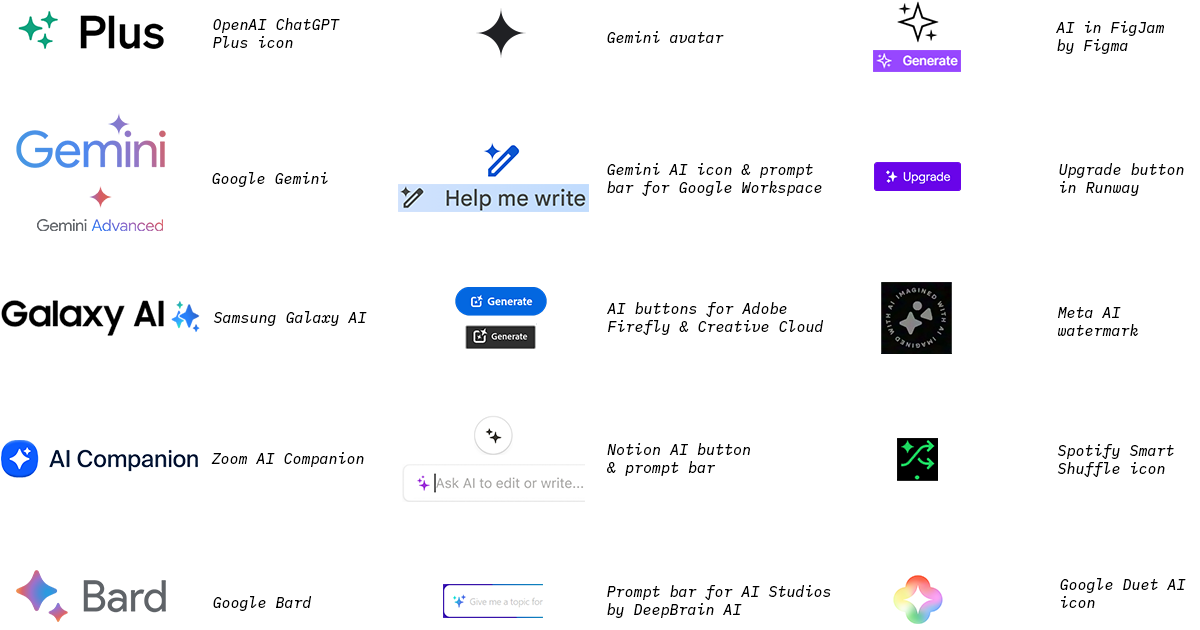
They’re all over lots of AI tools. They feature prominently in logos and wordmarks for some services, and more subtly across UI (user interface) elements such as icons, buttons and other graphics. Like the association of the plus symbol (+) with streaming services ⟨ go on, list them! Disney+, Apple TV+, Paramount+, MGM+, Discovery+, AMC+, 7+ and more! ⟩ sparkles have become a common visual element in many AI tools. But there’s more to their use of the diamond star shapes than fun and whimsy. The Sparkles emoji is often associated with magic, and these AI developers are intentionally using magic as a metaphor.
In my opinion, there are a number of reasons for this:
- Concerns about killer robots – From 2001: A Space Odyssey’s HAL 9000 to the entire Terminator franchise, science fiction and popular culture have positioned humans against killer robots run by AIs. Its a great trope, but one that has also left a lasting impression on a lot of people. Now, as AI tools emerge from the tech fringes, the companies behind these AI tools are working hard to break free of the genre’s lethal autonomous weapons (LAWs) associations.
"From 2001: A Space Odyssey's HAL 9000 to the entire Terminator franchise, science fiction and popular culture have positioned humans against killer robots run by AI."
- Artists copyright anxieties – AI is data hungry. So hungry in fact that there are concerns we will run out of content on the public internet to feed into AI systems. Of course, it begs the question where content up to now (and in the future) comes from? And who owns it? While it remains complicated to determine exactly how, when and where copyright infringement occurs across the AI lifecycle, there is no question that copyright material not owned by the technology companies building AI tools has been used in the training data. Couple with this the lack of transparency around what material has actually been used for training purposes and you can understand what creators are concerned. ⟨ Interestingly, when you look at the early court decisions in a number of recent copyright matters related to AI claims that the models are infringements themselves and that any output generated by them is an infringement are being dismissed. It seems largely what is surviving is infringement at the training data stage. But I feel that’s a separate blog post. ⟩
- Bias & other bullshit – On top of the copyright concerns segments of the public are rightly concerned about a swath of other issues bundled into AI. Biases in training data, the potential for large-scale displacement of jobs, secrecy, a lack of transparency, surveillance, facial recognition, AI exacerbating inequalities, automated decision-making (ADM) systems and shift of the 'locale' of decisions to AI (especially where decisions impact people’s lives) and just a few of the concerns. Naturally, there is a lot of concern and controversy about AI tools. And each of these feed into larger existential crises around AI.
- AI’s promise & possibility – On the flipside, AI is cutting-edge technology full of promises and new possibilities. Advocates and evangelists may overstate the benefits, but it is true that AI can contribute positively to society. It can increase productivity , it is as good if not better at diagnosing diseases , it can analyse data and identify patterns more quickly than humans , and myriad other things. ⟨ It is certainly much better than me at creating images of cats! ⟩ The graph below by the McKinsey Global Institute plots the potential value AI will add to a range of industries, shown in billions of (presumably US) dollars. Industries include aerospace and defence, telecommunications, insurance, consumer packaged goods, healthcare systems and services and retail.
- Making magic – For those who are new to these tools, they can seem almost magical. They ⟨ seemingly! ⟩ create something from nothing and are able to do things that once seemed impossible. And they can do things much quicker than we can. This is not surprising though; as the last of Arthur C. Clarke’s three laws says, "Any sufficiently advanced technology is indistinguishable from magic."
Given there are both positive and negative perceptions of AI, it is not surprising that developers of AI tools are leaning in to the more positive associations. Using the Sparkle emoji extends all the wonder and excitement tied to the emoji to AI tech. It adds playfulness and lightheartedness to the tools, making AI feel more approachable. Sparkles are also associated with magic – which leverages the existing touch of magic AI enjoys.
It turns out I am not the only one who has had this thought. andboth explored the phenomena, and Daley Wilhelm used Medium to dig into the history of the association between Sparkles and AI. Still, it seems obvious to me that the presence of sparkles in AI tools is an intentional indicator that ‘the magic of AI is just a click away’.
Concluding comments
The use of diamond star shapes in association with AI is an increasingly common trend among tech companies putting out AI tools. Meta, Google, Samsung, Adobe, Open AI and more have used version of the Sparkles emoji shapes in their offerings. The association is intentional and serves to evoke the magic and wonder of AI. This is not surprising given AI is up against the well entrenched ‘killer AI’ genre and anxieties and attacks on AI from different parts of society. It is unsurprising that AI developers are keen to tell a different story.
⟨ PS extra points will be given if you get the reference in the title! ⟩
Useful link
- How ✨ became the unofficial AI emoji, Michelle Cheng, Quartz, Friday 1 December 2023
- How the sparkles emoji took over AI, Shubham Agarwal, Fast Company, Saturday 17 February 2024
 Rishi Shah
 Daley Wilhelm
Colophon
Reuse
Credits
In order of appearance:
- Image: Examples of the use of the diamond star shape (stars with four points) used by AI developers in their branding and UIs (user interfaces). Compiled by Elliott Bledsoe. Each are the copyright and trade mark of their respective owners.
- Graph: Analysis by the McKinsey Global Institute of the potential value AI will created annually across a range of sectors. © McKinsey & Company, ‘Artificial intelligence (AI) has the potential to create value across sectors’, 2018. I consider the use of the graph a fair dealing for the purpose of reporting news. For more information on that exception see Use of third-party content in the Terms & conditions.
AI use
No part of the text of this blog post was generated using AI. The original text was not modified or improved using AI.
Provenance
This blog post was first published on Tuesday 23 April 2024. It has not been updated. This is version 1.0.