
Meta has made AI weird, the open community is building open training data and there’s lots of new reports to read.
Don't just read the introduction. Free members can read the entire weekly WTF now?! round-up. Sign up and keep reading.
Read
What I've been reading the week:
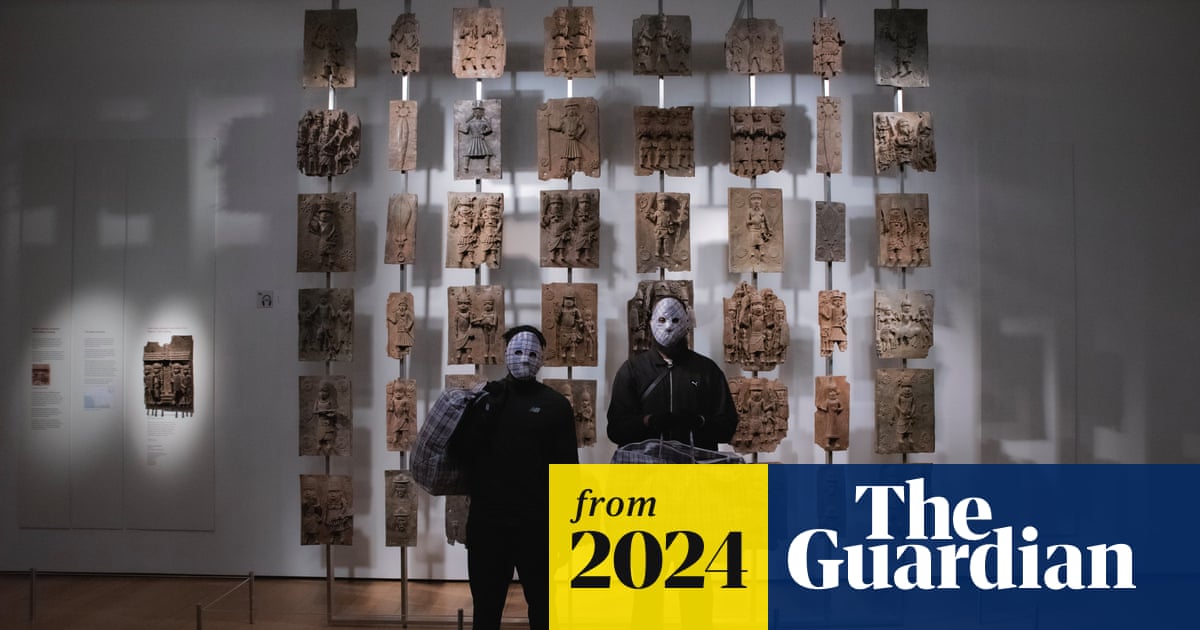
‘Can you steal back something that’s already stolen?’: how radical art duo Looty repatriated the Rosetta Stone
Art duo repatriate digital surrogates of culturally significant objects taken during colonisation.
Art duo Looty have been digitally repatriating artefacts such as the Rosetta Stone to their places of origin using a bevvy of tech, including Lidar 3D scanning, location-based augmented reality (AR), blockchain and non-fungible tokens (NFTs) technology. The art duo are ‘looting back’ stolen cultural artefacts from museums founded in the colonial era. It’s a clever but also very important project for raising awareness of the importance of repatriation of cultural property to their country or community of origin. Just days before this article came out, a ceremony held in the Wren Library at Trinity College Cambridge saw four spears taken by James Cook and Joseph Banks on 29 April 1770 permanently repatriated to the La Perouse Aboriginal Community.
 Alexander Durie
Common Corpus: Building AI as Commons
AI models were built on copyright material used without permission, but what if they were trained on open licensed material?
As the AI and Copyright court cases continue we are seeing AI companies shift to direct licensing deals. If this trend continues ⟨ and it very likely will⟩ Style: italics there’s “… more risk of gatekeeping, as only the largest companies will be able to afford the licensing costs." The recently launched Common Corpus public domain dataset for training large language models (LLMs) “… is an attempt to address these challenges by presenting a new way of contributing to the development of AI as Commons.” It’s built on open data, “CC-licensed YouTube videos, 21 million digitized newspapers, and millions of books …” and “… reflects a vision of fostering a culture of openness and accessibility in AI research.” To say I am excited about this endeavour is such an understatement!
 Alicja Peszkowska Alek Tarkowski
Meta's AI search is weird and uncanny — and I'm not sure who it's for
Everything about Meta AI is weird, starting with where to find it.
Katie Notopoulos takes a funny look at how weird and out of place Meta AI is in the Facebook and Instagram apps. Placing it in the search section is weird enough, but given how much data Meta has on all of us, its its suggested AI prompts are strange ⟨ and often shallow. ⟩
 Katie Notopoulos

How advertising, not social media, killed traditional journalism
The News Bargaining Code didn't address the fact that news isn't a high priority for social media.
In a piece that is similar to Alex Bruns’ blog post in last week’s Reading list, Amanda Lotz has a piece on 360 that argues that social media and news are both in the attention business, and that attention was used to prop up their business models by selling advertising. As Lotz said, “The development of more effective and efficient advertising tools is what killed traditional newspaper operations, not the circulation of news on social media.” We know Meta is increasingly convinced news isn’t that important to its platforms. We also know that the News Bargaining Code didn’t address the core of the problem for journalism. And we know that journalism is good for democracy. But we also know that governments aren’t that interested in funding journalism. So the problem persists.
 Authors Amanda LotzQueensland University of Technology
Add it to the pile
New additions to the unread pile:
Countess Report 2022
More data on gender disparities in the arts.
I haven’t had a chance to read it yet, but I am keen to get into the third edition of the arts sector-wide report on gender representation in the Australian art sector. This report also included First Nations representation for the first time. NAVA has a detailed news article about the report, and it was covered in a number of media outlets, including The Guardian.


The Big Picture 4: Public Expenditure on Artistic, Cultural and Creative Activity by Governments in Australia in 2007-08 to 2021-22
Arts funding in Australia is slipping.
A New Approach (ANA) also released an important report this past week: the latest report in The Big Picture series “… tracking the long-term trends in arts and cultural investment by all three levels of government in Australia, shining a light on how governments are supporting the creators, activities and institutions that connect communities.” This report notes that “… while government spending on arts and culture increased in 2021-22, it is still not keeping pace with population growth nor with our OECD peers. The scale of cultural funding by state and territory governments is now neck and neck with the federal government, while the local government share has decreased.”
 A New Approach
Content Moderation in a Historic Election Year: Key lessons for industry
No surprises, but social media plays an important role during elections.
I also haven’t read it yet, but the Oversight Board has put out a report on social media platforms and election content moderation. It notes, “… [2024 is an] historic year of elections, with the populations of at least 80 countries around the world set to participate, there has never been a more critical time for democracy, human rights, and open and fair societies.” Given the role social media plays in disseminating political material and hosting political discourse, the Oversight Board has released key lessons for social media platform operators which should be important reading.
 Neena

Colophon
Reuse
AI use
No part of the text of this blog post was generated using AI. The original text was not modified or improved using AI.
The banner graphic (i.e. the first image at the top of the blog post) was adapted from vector graphics generated in Adobe Illustrator using Firefly 4 with 'Subject' content type selected and the lowest level of detail set. { Text to Vector Graphic prompt: Seamless pattern, very large simple shapes, 80s retro style, fluid organic elements, morphing, overlapping, blurred gradients, visible layers }
Provenance
This blog post was first published on Sunday 5 May 2024. It has not been updated. This is version 1.0.