
In 2001, Wikipedia was launched. So was Creative Commons (CC). Both are crucial parts of the open movement and free knowledge. But 25 years later and we are still grappling with the fact that the core belief structures, practices and infrastructure of open relies on Western knowledge traditions and Western intellectual property (IP) law. Open projects adopt Western knowledge production systems, individual authorship, information neutrality, verifiability of sources, scholarly research and reuse of copyright, especially where content is openly licensed under a CC licence. That legacy is at odds with Indigenous ways of knowing, being and doing.
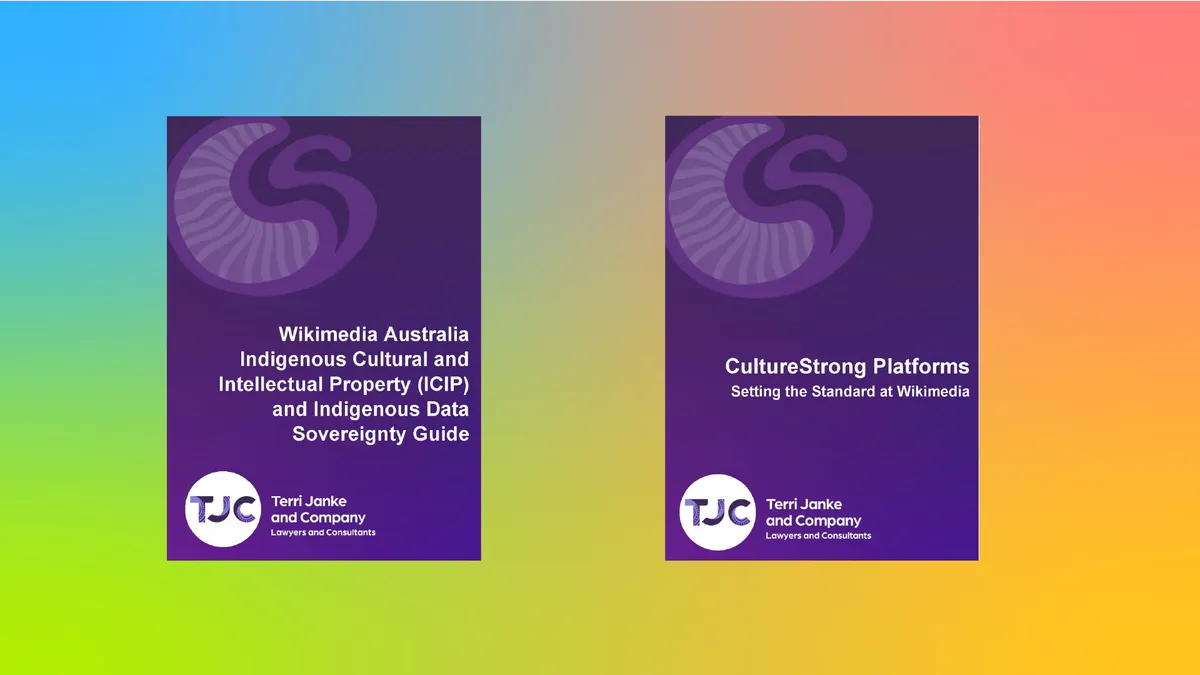
There is much work to be done by open communities to reconcile the goals of free and open knowledge with respect for Indigenous content and honouring self-determination. In one step towards that vision, today Wikimedia Australia (WMAU) released the Wikimedia Australia Indigenous Cultural and Intellectual Property (ICIP) and Indigenous Data Sovereignty Guide, and its companion white paper CultureStrong Platforms: Setting the Standard at Wikimedia. Both of these documents were written and researched by Dr Terri Janke, Shevaun Wright and Matilda Langford.
Developed through an Indigenous-led process, these publications provide practical guidance for Wikimedia contributors, while asking important questions and opening an international conversation about respecting Indigenous knowledge, cultural authority and self-determination within one of the world's largest open knowledge movements.
This work is really important to WMAU. I would say, perhaps boldly, this work will also be important for the Wikimedia movement worldwide – even if they don’t know it yet.
The wiki world must do better at respecting ICIP and Indigenous agency over Indigenous content – not just because it is the right and responsible thing to do and certainly not because of future compliance coming with stand-alone legislation to protect ICIP. Simply, we must do this because the knowledge that is shared on our platforms should arrive there in ways that are inclusive, just, equitable, reciprocal and sustainable. For knowledge to genuinely be open the owners of that knowledge must want it to be.
I hope the guide and white paper – which Terri and Shevaun will speak to at Wikimania Paris next week – will help shift the workflow from ‘open at all costs’ to open with care. It is also a recognition that wiki platforms do not have to be ‘the place’ for all knowledge, especially First Nations knowledge shared without cultural authority.
The guide isn’t a checklist, it is an invitation. My hope is that it will encourage Wikimedians to stop and think when sharing Indigenous content; to think whose knowledge it is, how it came to be where it is, and what responsibility comes with sharing it with the world.
Adapting will be a challenge – but Wikimedians love a challenge! Cultural competence is a lifelong pursuit, and for some Wikimedians the WMAU ICIP and IDSov Guide and white paper may be their first step on that journey. Just know you are not walking it alone.
My deep thanks and admiration to Dr Terri Janke, Shevaun Wright and Matilda Langford at Terri Janke and Company for walking this path with us. I also extend respect and gratitude to the Indigenous Expert Working Group who have helped inform the guide – Leonard Hill, Dr Jessica Russ-Smith, Dr Kirsten Thorpe, Dr Tamika Worrell, Yanti Ropeyarn and Miriam Corowa.
I would also like to get on the record a few other thank yous: thank you to Belinda Spry, Executive Officer at WMAU for unwavering support of this project. Also thank you to the WMAU team – Alice Woods and Alison Smith – and the WMAU Board who have all been fully behind this project.
Colophon
Reuse
Conflict of interest
I am the Co-lead of Creative Commons Australia (CC AU). The views expressed in this blog post are my own and do not express the views of CC AU or the Creative Commons Corporation.
I am the President of Wikimedia Australia (WMAU). The views expressed in this blog post are my own and do not express the views of WMAU.
Credit
AI use
No part of the text of this blog post was generated using AI. The original text was not modified or improved using AI.
Provenance
This blog post was first published on Thursday 16 July 2026. It has not been updated. This is version 1.0.