
You may have noticed that you can’t post more than 2 links on Facebook now. If the restriction hasn’t impacted you yet, expect it soon.
It will be a shock.
Get angry.
Then get organised.
For artists and arts organisations that have long relied on social media to tell people about their arts experiences and drive web traffic and ticket sales, this sudden change to how Facebook works will be a major disruption. The shift is clear: external traffic is now a paid feature. A strategic arts marketing response is needed.
Meta may think brands will willingly or begrudgingly take up their subscription options – and that may be the case in industries where marketing communications are well resourced and a ‘just pay it’ as a cost of doing business mentality applies – but for sectors like arts and culture where tight organisational budgets mean lean marketing allocations that uptake will likely be smaller. If you are in that boat, I have shared some ideas about what a decentering of Facebook in a marketing strategy might look like, and how to build a more resilient, multi-channel marketing approach.
If you are enjoying this free content, please consider becoming a free member so you can read the member only content. Sign up and keep reading.
Meta One & the two-link limit
In a bid to keep people on Meta platforms longer the social media giant has been quietly discouraging links to external websites for over a decade. That war on click-throughs ramped up in late 2025 when Meta started enforcing limits on the number of links on certain accounts and has escalated dramatically since September this year when they introduced Meta One, a subscription model touted as ‘bring[ing] more value to the apps and experiences billions of people already use’ but that actually just another example of BigTech rent-seeking. Meta One includes subscription options for individuals and Creators and Businesses (i.e. users with a Creator account and companies and organisations using a Facebook Page).
Maybe a verified badge, impersonation protection, a built-in LinkInBio tool and increased monthly AI usage allowances is valuable to some brands, but to me the devil in this detail was buried. Hidden amongst all the Meta One marketing spin is a vague reference to links, but in actuality the scheme brings in severe link limiting restricting the number of links Creators and Facebook Pages can publish. The limit applies to posts with a link preview, image or video posts that include a link in the text of the post and links in comments.
This week was the first time I have seen it myself in the wild. When scheduling some social media posts in Meta Business Suite for a client I saw a small red notification informing me that the client’s Facebook Page has ‘0 links remaining’. When I switched to trying to schedule the post through facebook.com instead I got a much more prominent warning.
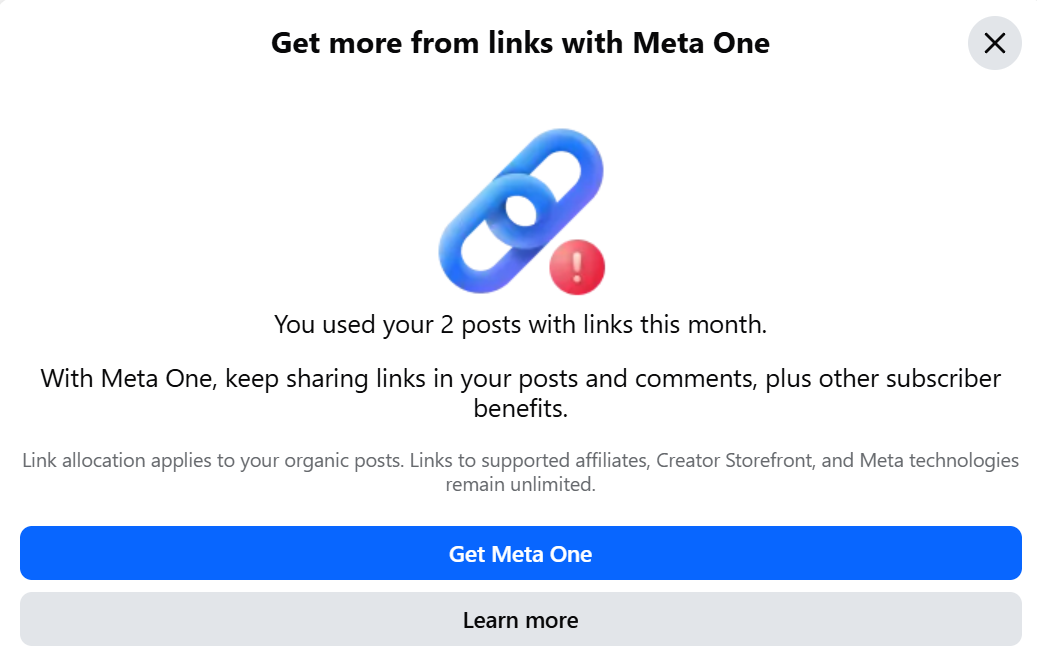
The Meta One page hides link limits behind pop-ups but a table on a Facebook Help Centre article lays it out much more explicitly:
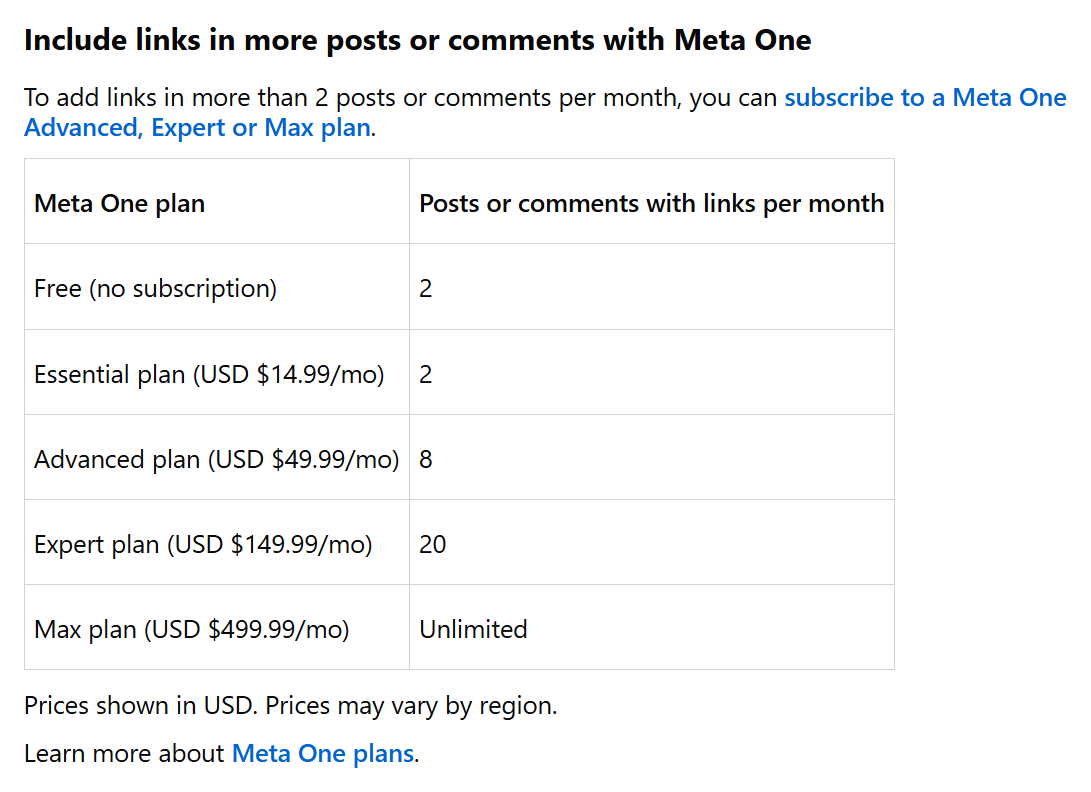
If your Facebook Page or Creator account has also been link limited and you want to publish posts or make comments with links more than twice a month you have no option but to opt for the Advanced at a minimum. It was difficult to find the Australian price but eventually I did:
Essential is AUD $22.99/month or AUD $275.88 a year ⟨ although, weirdly I also saw it listed as AUD $17.99/month in a different location! ⟩
Advanced is $76.99/month or AUD $923.88 a year
Expert is $229/month or AUD $2,748 a year
Max is $769/month or AUD $9,228 a year
So to be able to post up to 8 links on Facebook under the scheme you have to spend nearly $1,000 annually!
The impact on small arts brands
There will be impacts for the gamut of arts and cultural brands from Meta’s move to a two-link limit. Large organisations will have to factor a new budget line into their ongoing marketing costs while smaller arts organisations will need to think carefully about where their scant marketing allocation goes. For many individual artists and community-run and volunteer arts organisations, the cost will be hard to bear. ⟨ Adding insult to injury, I have seen no evidence that Meta will provide a nonprofit discount on Meta One plans. ⟩
The risks and realities of reduced links on Facebook content for arts brands is palpable. A two-link limit challenges entrenched ways of doing arts marketing because arts brands have largely seen social media as traffic generation for their websites or ticketing platforms. Frequent link-sharing to support diverse programming, cross-promotions and free community engagement is no longer viable. Given how ingratiate the Meta platforms are in people’s lives, how difficult it is to extricate your brand and your audience from them remains to be seen. Likewise, the ROI (return on investment) of on-platform content and engagement just for Facebook is difficult to conceptualise at the moment.
For many arts brands, Facebook had served as a primary pathway connecting audiences to purchasing, as well as descriptions, artist profiles, important information and other content. Outbound link restrictions throttle that part of the customer journey, severely hampering conversion funnels and threatening revenue such as box office sales and donations. The timing of Meta’s rollout is particularly bad given tomorrow is Australia's national day of giving to the arts, AusArt Day.
Options for small arts brands
If your Creator account or Facebook Page hasn’t been link limited yet expect it soon. Once you are, you will have to make some strategic decisions about your ongoing use of Facebook as a marketing channel. You may either suck it up and take out a monthly subscription or seriously curtail your use of links on Facebook.
Opt in to Meta One
Let’s say you decide to subscribe, even opting into Meta One Advanced for nearly $1,000 a year only gets you 8 links a month which is roughly 2 a week. This likely will still require you to do some rethinking about your use of links on Facebook because your pre-link limit usage probably sees you post more than two posts or comments with links per week.
If you have higher volume needs then you may be looking at an Expert plan which is nearly $2,800 a year. This will be a reality for performing arts venues, visual art galleries, bands and many other arts brands supporting multiple events at once.
Whichever subscription level you opt into arts brands will need to review their marketing ROI (return on investment) thinking. Ticket sales conversion from socials has been a kind of fuzzy science but if you are shelling out monthly for click-through traffic you are going to want to be more certain ticket buying results. Without better ROI calculations subscription costs can rapidly outpace returns.
Rethink links in your marketing approach
The marketing rhythm of common high volume time-based reminder marketing approaches that push out messages like ‘Tickets on sale now’, ‘Two weeks left to book’ and ‘Only 10 seats left’ that include links to event ticketing will need to change. Unless you shell out for a Max plan with unlimited links you will need to reconsider how you use links on Facebook no matter which tier you are on. While the 20 links you get with Expert are useful, you still likely can’t be linking like you used to.
If you are on the lower-tier Advanced subscription there is no question you will have to limit your links. You will need to reserve links for high-priority announcements or things that need a more concerted push. Where possible, you should also reserve one or two links a month to build less restricted marketing channels like email newsletters.
Whichever way you go, a reduced link allowance means a marketing approach that leverages alternative drivers to your ticketing platform or website. Promotional images, trailers, behind-the-scenes content, interviews and the like should already be in your promotional content mix, but you will need to lean even further that direction as you navigate low-link marketing. More investment in high quality and visually impactful content will be needed and this will need to be coupled with CTAs (calls to action) that encourage people to ask their AI chatbot about you, search for you or go to a LinkInBio. All of these are multi-step processes so conversion will be difficult.
Up your ad spend
Alternatively or in tandem arts brands could increase their advertising spend on Facebook because links that are part of ads are not counted in the link limit. While ads or boosted posts may have been reserved for major pushes like early-bird or opening night tickets in the past, this new reality may call for a more consistent and wide-spread advertising approach where small amounts are allocated to more content than before.
Of course, the benefit of ads is that you can be highly targeted in terms of who sees them but can require more planning to get right.
Linking within Meta platforms
Because links to Meta-owned platforms – Facebook, Instagram, Threads and WhatsApp – are also not part of the limitation on links, consider internal opportunities. One approach that could work for some arts brands is to embrace Facebook Events because there is no limit to the number of posts on events that can include links. Organic posts on your Facebook Page could then point people to your Facebook Event where you are not link restricted. Of course, not everyone following your Page will bother to go to the event.
While posting in Facebook Groups could be another pathway to explore, apparently posts in groups by Facebook Pages are within the link limit, but comments are not. I haven’t tested it myself but it could mean sharing posts in groups from your Page and then including a link in a comment on your post might work. How useful this is in driving web traffic and ticket sales is equally uncertain.
Taking an IMC approach
An integrated marketing communications (IMC) approach to link limits could be the key to decentering Facebook in your marketing efforts. Because you can’t rely on Facebook to be the main driver of buying traffic you need to bolster owned channels such as your website, ticketing platform and email newsletter. While it may be tempting to use your 2 links on direct pushes, resist the urge and allocate them to encouraging people to create an account on your website and/or sign up to receive emails from you. To complement this, arts brands could consider investment in other marketing options such as publicity, public relations (MPR), OOH (out-of-house) advertising and in-venue digital screens.
Concluding comments
Meta’s link restriction is a ‘line in the sand’ moment for social media. Arts and cultural brands must decide if business-as-usual means absorbing Meta’s extractive One subscription costs or whether to downplay their use of Facebook as a marketing channel. A budget-friendly multi-pronged approach that embraces the latter will mean reserving links for high-priority purposes, reinvesting marketing effort into owned channels such as electronic direct mail (EDM) and exploring options for internal features such as Facebook Events.
Colophon
Reuse
Conflict of interest
I am an arts marketing consultant.
Credits
Other images in order of appearance:
Screenshot: A pop-up notification on Facebook about link limits. © Copyright Meta 2026. I consider the use of this screenshot a fair dealing for the purpose of reporting news by means of a communication. This material is excluded from the Creative Commons licence that applies to this blog post.
Screenshot: A table showing Meta One subscription tiers and corresponding number of links per month. © Copyright Meta 2026. I consider the use of this screenshot a fair dealing for the purpose of reporting news by means of a communication. This material is excluded from the Creative Commons licence that applies to this blog post.
AI use
AI was used to generate ideas and interogate the subject matter of this blog post, but no AI-generated content was used verbatim.
The banner graphic (i.e. the first image at the top of the blog post) was adapted from vector graphics generated in Adobe Illustrator using Firefly 4 with 'Subject' content type selected and the lowest level of detail set. { Text to Vector Graphic prompts: Large broken link icon exploding to the left and right, very large simple shapes, 80s retro style, line drawing, visible layers. }
Provenance
This blog post was first published on Wednesday 12 October 2026. It has not been updated. This is version 1.0.