
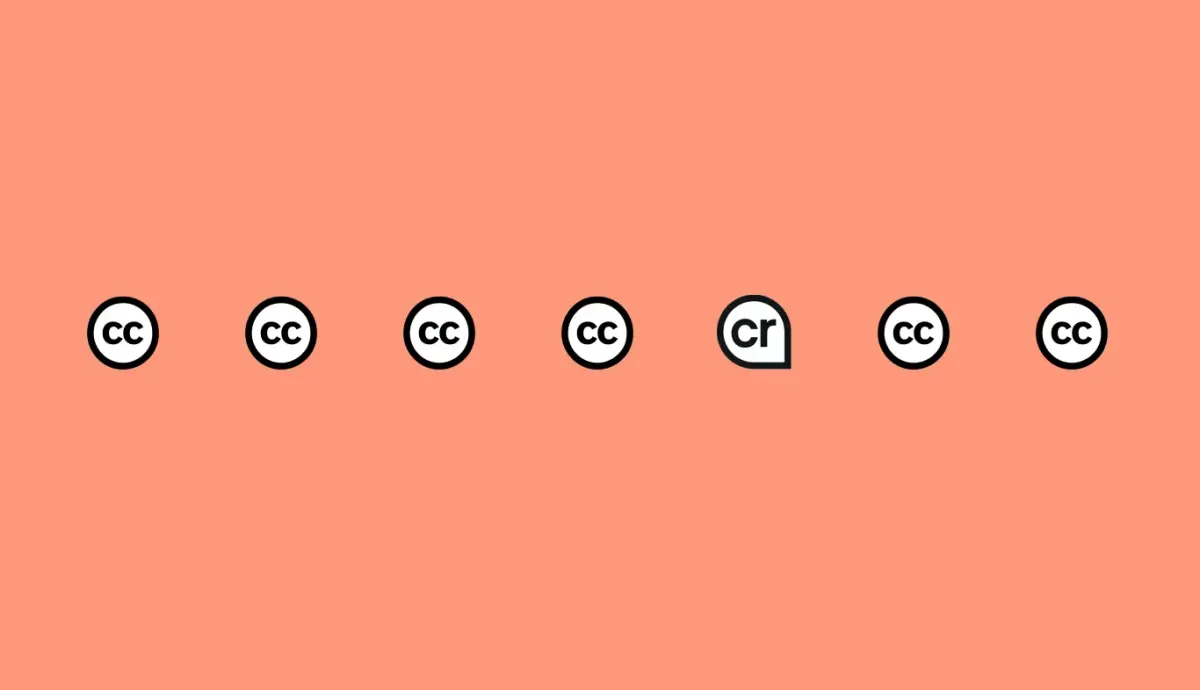
Content Credentials aims to build credibility and trust by providing users with information about the content they are looking at. There is no question more transparency around content is needed – especially where AI is concerned – but the Content Credentials pin is similar to Creative Commons' CC icon if you ask me. I am concerned that could create confusion among users if the Content Credentials pin is mistaken for indicating material is licensed for reuse under CC.
I recently found out about Content Credentials, a content transparency initiative spearheaded by Adobe. It relies on content labelling and content verification to build credibility and trust by informing users of content’s creator, its provenance, the use of generative AI tools in its creation and the issuer of the credential [C2PA, n.d.] A floating Content Credentials pin displays information drawn from “tamper-evident metadata” [Adobe, 2024] in a pop-up when a user clicks on it. Adobe says, “This information allows creators to receive more recognition for their work, connect with others online, and enhance transparency for their audience” [Adobe, 2024].
It’s new to me, but it turns out that the pin was launched in October last year. Since then, it has been gaining momentum. Overall, I am supportive of content transparency and content labelling. However, when I first looked at the website the visual representation of the Content Credentials pin (the ‘CR’ icon) work immediately made me think of the Creative Commons CC icon. What do other people think?
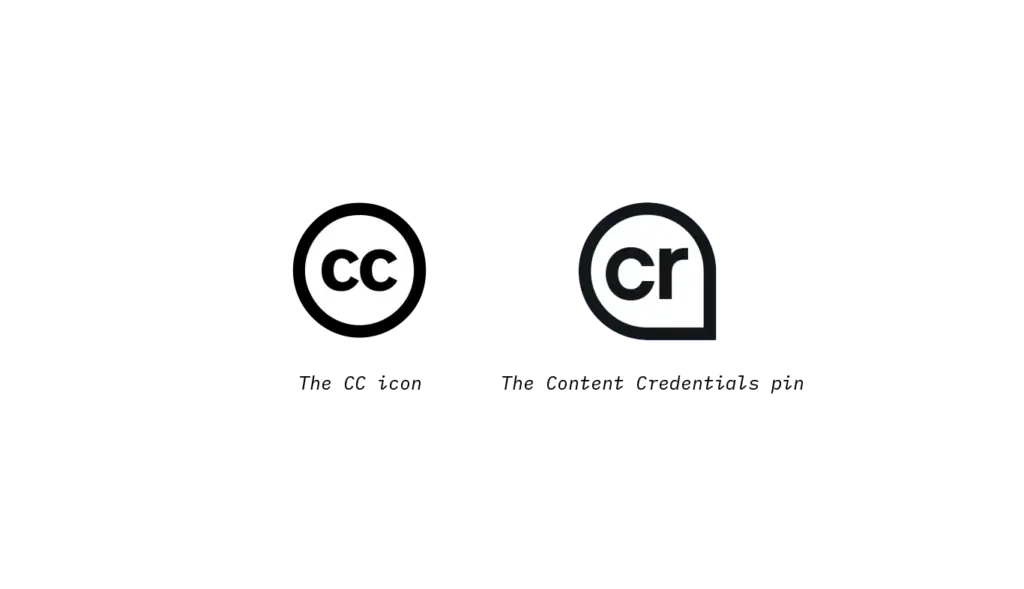
Interestingly, reporting on the launch of Content Credentials (such as on The Verge) says they opted for the initials ‘CR’ “to avoid being confused with the icon for Creative Commons” [David, 2023]. Even so, in my opinion, the Content Credentials pin will create confusion for the public because it looks so much like the CC icon. The icons are very similar to each other:
- both have black elements with a white fill,
- both feature two lowercase letters in a heavy san serif font,
- both are intended to be displayed at a small size, and
- the CC icon is a circle and the Content Credentials is a teardrop shape (rounded except for one point).
" … the Content Credentials pin will create confusion for the public because it looks so much like the CC icon."
The full logos for each brand only exacerbate the similarities. I think it is pretty likely Adobe looked at how CC built a community around its licences and the tools that go with them. Beyond the visual similarities, both schemes are designed to signal information about the content they relate to.
To be clear, I am not against the endeavour to label AI content. Nor am I against Content Credentials. My concern is that users may mistake the Content Credentials pin for indicating material is licensed for reuse under a CC licence and think they can reuse the material.
In fact, I think there are genuine merits to Content Credentials. If it manages to get the uptake it is after it really could positively contribute to tackling mis and disinformation. And that is definitely a good thing.
And there are things about how they have designed the system that I really like. CC could incorporate some of the pros of Content Credentials. For example, there is something elegant about the way it brings transparent information to where users are. I would love to see the CC badges move in this sort of direction; placing important information about the creator and how the content can be reused in a pop-up that appears when you click on the badge, essentially bringing the Commons Deed information and information about the content to where the user is, rather than expecting the user to navigate elsewhere to find out more.
On the flipside, I think there is room for both schemes to be integrated. I would love to see Content Credentials include copyright and licensing details in the information listed.
References
Adobe (2024) ‘Content Credentials’, https://helpx.adobe.com/creative-cloud/help/content-credentials.html.
Coalition for Content Provenance and Authenticity (n.d.) ‘Content Credentials’, https://contentcredentials.org.
David, E (2023) ‘Adobe created a symbol to encourage tagging AI-generated content’, The Verge, https://www.theverge.com/2023/10/10/23911381/adobe-ai-generated-content-symbol-watermark.
Disclosure
Conflict of interest
I am the Co-lead of Creative Commons Australia (CC AU), I am an individual member of the Creative Commons Global Network and I have been involved with the TAROCH (Towards a Recommendation on Open Culture) project which is led by CC. The views expressed in this blog post are my own and do not express the views of CC AU or the Creative Commons Corporation.
AI use
This blog post was drafted using Google Docs. No part of the text of this blog post was generated using AI. The original text was not modified or improved using AI. No text suggested by AI was incorporated. If spelling or grammar corrections were suggested by AI they were accepted or rejected based on my discretion (however, sometimes spelling, grammar and corrections of typos may have occurred automatically in Google Docs).
Colophon
Reuse
Conflict of interest
I am the Co-lead of Creative Commons Australia (CC AU) and I am an individual member of the Creative Commons Global Network (CC GN). The views expressed in this blog post are my own and do not express the views of CC AU or the Creative Commons Corporation.
Credits
The Creative Commons icon is a trade mark of Creative Commons Corporation. My use is a referential use per the Creative Commons Trademark Policy. This material is excluded from the Creative Commons licence that applies to this blog post.
Content Credentials is a trade mark of Adobe, Inc. This material is excluded from the Creative Commons licence that applies to this blog post.
AI use
No part of the text of this blog post was generated using AI. The original text was not modified or improved using AI.
Provenance
This blog post was first published on Friday 4 October 2024. It has not been updated. This is version 1.0.